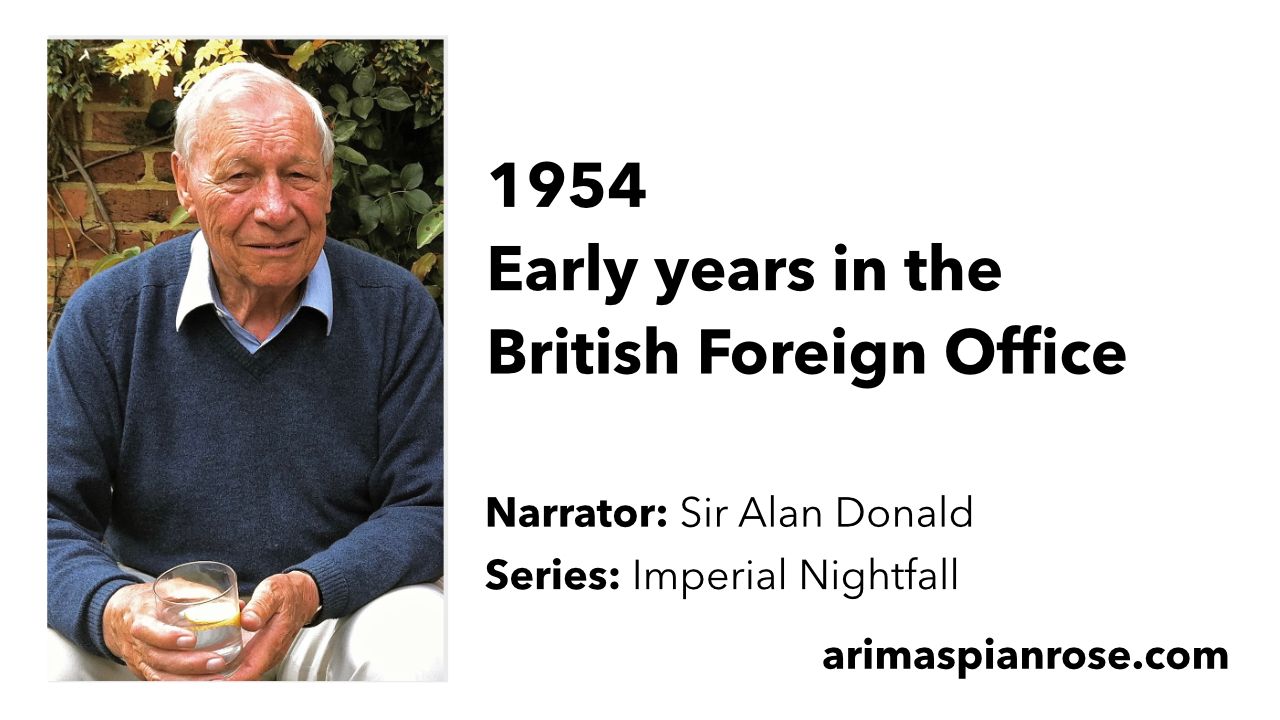
Sir Alan Donald recalls how one of his first jobs in the British Foreign Office in 1957 was to work on setting up a rival to the European Common Market. Britain had been denied entry to Europe by France and so tried to set up a rival organisation called the European Free Trade Association (EFTA). He also comments on the deep rift in the Foreign Office between those who favoured Europe and those who believed Britain should stick closely to the USA. A rift that still exists today!
Sir Alan Donald remembers his first trip to China by boat in 1955. It was a journey that took 5 weeks stopping at every British coaling party on the way – Port Said, Calcutta, Penang, Hong Kong. He was astonished to find that life in Shanghai at that time in the 50s – even after the Communist revolution – had not changed since the 1930s.
Sir Alan Donald remembers applying to get a job with the British Foreign Office in 1954. He failed the first time but finally succeeded and went on to great things.
Part of the interview process involved a visit to Saville Row – I thought that part of the movie “Kings Man” was pure fiction… but it turns out there was a grain of truth in it!
The British Army of the Rhine (BAOR) was the name for the British occupation forces stationed in Germany following World War II, officially established in August 1945 from the 21st Army Group. Based in West Germany, it served as a primary NATO land force during the Cold War to defend against the Warsaw Pact, operating until 1994.
Key Details About the BAOR:
Purpose: Initially established for the occupation and administration of the British Zone in north-west Germany, it later became a core component of NATO’s Northern Army Group.
Timeline: While a smaller, short-lived force operated from 1919–1929, the main BAOR was active from 1945 to 1994.
Role: The BAOR was responsible for protecting the North German Plain during the Cold War.
Disbandment: Following the end of the Cold War and the “Options for Change” defence review, the force was reduced and eventually disbanded in 1994.
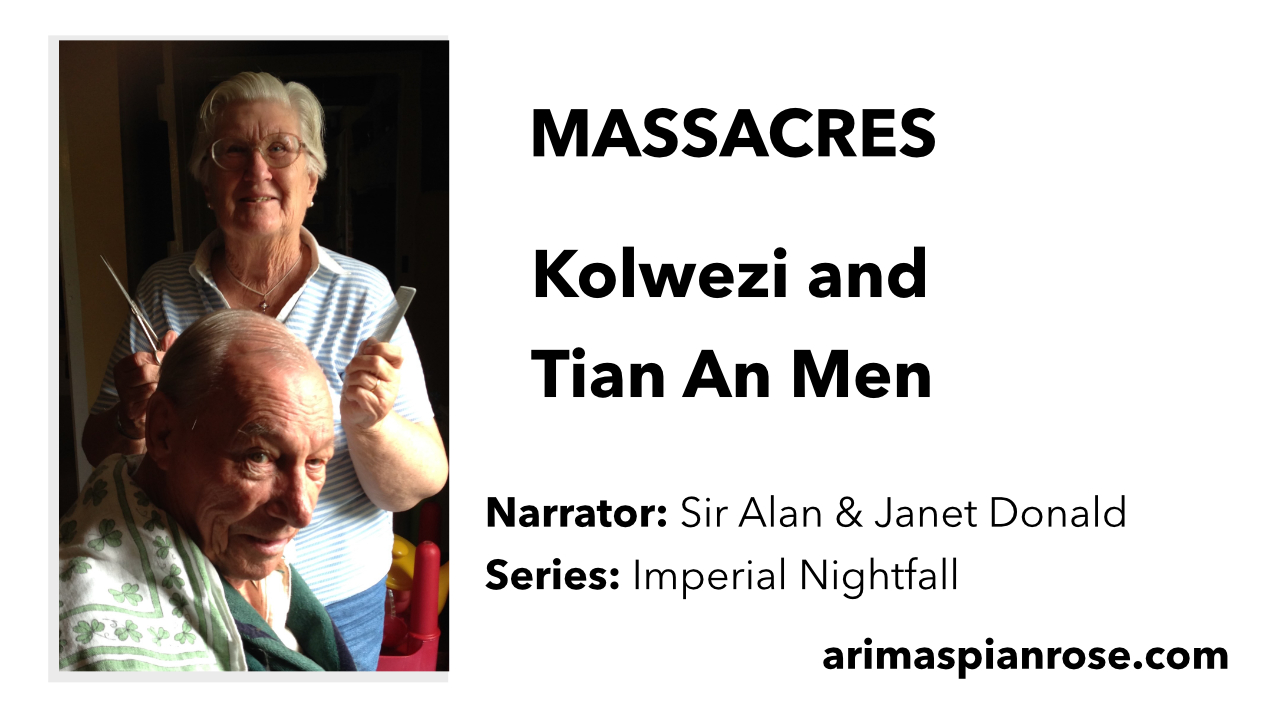
Sir Alan Donald served as the British Ambassador to China and earlier to the Congo DRC, then known as Zaire. During that time he witnessed two momentous events – Massacres at Kolwezi in the Congo and in Tiananmen Square in Bejing. In this video he recounts how experiences
Background Context :
The Tiananmen Square Massacre, also known as the June Fourth Incident, occurred on June 4, 1989, in Beijing. It was the culmination of weeks of student-led pro-democracy protests sparked by the death of Hu Yaobang, a reform-minded Communist Party leader.
Key Events
Protests (April–May 1989): Demonstrations began in April, with students demanding political and economic reforms, including freedom of the press and an end to corruption. By mid-May, numbers swelled to an estimated one million people in Beijing.
Martial Law (May 20, 1989): Following internal division within the Communist Party, hardliners led by Premier Li Peng and supported by Deng Xiaoping declared martial law to suppress the “counter-revolutionary riot”.
The Crackdown (June 3–4, 1989): On the night of June 3 and the early morning of June 4, the People’s Liberation Army (PLA) advanced toward Tiananmen Square using tanks and live ammunition. Much of the violence occurred on the roads leading to the square, such as Chang’an Avenue.
The Kolwezi massacre refers to the mass killing of civilians in the mining town of Kolwezi, Zaire (now Democratic Republic of the Congo), in May 1978. The event occurred during the Shaba II conflict when rebels from the Congolese National Liberation Front (FLNC) invaded the town.
Key Facts of the Massacre
Perpetrators: The killings were carried out by FLNC rebels (often called Katangan rebels) who invaded from bases in Angola.
Casualties:
Estimates indicate that between 120 and 170 European expatriates (mostly Belgians and French working in the mines) were killed.
Approximately 700 African civilians were also killed during the occupation.
Atrocities: Survivors reported summary executions, including the murder of 34 men, women, and children in a single house. Victims were often targeted based on race or their connection to the mining industry.
On another memorable trip, we went to Mbuji Maya to inspect some diamond mines at the invitation of de Beers. A young man was deputed by the company to act as our host and guide for the weekend. The programme envisaged a trip by boat up the river from Mbuji Maya to visit the area where the diamonds were being dug, a night in the camp there and a return by the river to Mbuji Maya before flying back to Kinshasa. We arrived at the place safely and on time at about noon on the Friday. To our dismay, we were told that the Mayor of the city wished to honour us with a lunch. It was nearly 3 o’clock before we got away from lunch and went to the jetty. The young man from de Beers had organized two inflatable rubber dinghies. We thought we were going to travel on a river steamboat in the style of Joseph Conrad. It was not to be.
We watched in awe as these two inflatable dinghies with outboard motors went roaring up and down the waterway. I asked what was going on. The guide said they were just testing the engines. This was rather an ominous start. We piled into one of the dinghies and the other was loaded with our baggage and we proceeded up the river.
By this time it was between 3:30 and 4pm, and I asked about the length of our journey. I was told it was about 50 miles. I did some quick calculations and worked out to travel this distance in a dinghy would take several hours and darkness always fell promptly at 6 o’clock. I began to have grave doubts about this whole expedition.
About half an hour up stream on the Lualaba river, we gradually became aware that our boat was starting to leak and in danger of sinking. The second boat was summoned and in the middle of the stream the luggage was put on our dinghy and we transferred ourselves rather perilously into the baggage dinghy. As we proceeded up stream, we could see coming towards us the father and mother of a thunderstorm. A thunderstorm in Africa has to be seen to be believed. The sky was dark, lit with flashes of lightening and it began to get really gloomy.
We got through the torrential rain all right, but we then lost touch with the second boat with all our belongings on board. It must have pulled into the bank to effect the necessary repairs. We found ourselves in the single dinghy proceeding alone. It was getting darker and darker because of the storm, and also because night was falling.
Round about 6 o’clock we found ourselves getting into shallower water and it was clear that we were now on a much smaller waterway than the main river. I asked the de Beers man if he was familiar with the river. “No”, he answered, “As a matter of fact, this is my first visit too”. I turned to one of the Zairian crew and asked if he was familiar with this stretch of water. “ Oh yes” he said, “ I know it like the back of my hand”. It became painfully obvious that he didn’t, because within a few minutes we were stranded on a sand or reed bank in the middle of this narrowing tributary. We asked if the boat had provisions or equipment of any kind for use in emergency. We discovered that it did not. They had assumed that they would travel the 50 miles in a couple of hours. Fortunately, Janet had got anti mosquito cream, fresh water and, most important of all, a bottle of whisky. So we hauled the dinghy up onto what appeared to be the bank of the river (which actually turned out to be a floating island). Janet settle down in the middle with a man either side of her to keep her warm. We plied ourselves with whisky and tried to sleep. It was pretty awful in the darkness with the mosquitoes. During the night we heard a hippopotamus stamping beside us through the reeds into the water.
In the morning there was a miraculous vision. As we looked out over the river, we could see a bank of fog just above the water level. Gliding down it with only the only the head and shoulders above the mist were one or two fisherman in their small canoes. It was rather mystical. We couldn’t attract their attention and I don’t think it would have done much good if we had.
We eventually got back into our own boat and decided we must retrace our path. It was quite clear in the daylight that we had come adrift terribly the night before and were on a tributary of the big river. We went back down the river and located the main stream. We turned right upstream again and continued forging up the river. It was then that the man who “knew the river like the back of his hand” announced that we were running out of petrol. If we didn’t land, we would be stranded in the middle of the river with no means of power. We spotted a small hut on the bank. We were able to get to the bank, anchor the dinghy, and clamber out. The fisher family who were roasting or baking fish in an oven made out of an old oil drum offered us food, which we cravenly declined. The fisherman was badgered into shinning up a tree to knock down what we thought was a coconut, which we hoped to eat for breakfast. Sadly it was not edible. We sat on the bank wondering what we should do next.
Janet and I thought that if we had not seen any sign of any help by midday we should get into the dinghy and float down stream using the current to get us back to where we started, some 20 or 30 miles away. At 5 minutes to 12, just when we were going to act on this manly decision,we heard this “putt, putt, putt” of an outboard motor and saw the second dinghy coming towards us downstream. It had passed us in the night, reached the diamond mine, not found us there and had come back to find us.
They happily had some petrol and we could therefore continue our journey, arriving at the camp at about dusk. To our horror, the Zairians announced that we had to leave next morning at crack of dawn as there was another banquet waiting for us downstream 50 miles away. At about this time, Janet and I became irritable and said we had not come all this way to turn round and go back again: we would spend the night there, look at the mines in the morning and go down at leisure, either the next evening or even the day after.
This was rather grumpily agreed to and we went to sleep in hammocks in a tent. There were mosquito nets, but when we got up in the morning we found there was an army of huge brown ants tramping through the tent. As I got out of my hammock, ants climbed up my trousers. It was a most unnerving and disagreeable experience. However we did return safely by river to Mbuji Maya and thence to Kinshasa, sadder and wiser and thankful to get home.