Sir Alan Donald recounts his Tim win National Service in 1949 – a mere 4 years after the Second World War ended.
You can see the video here

He did basic training at Ranby Camp as part of the Nery Gun battery in the Royal Horse Artillery
Sir Alan Donald recounts his Tim win National Service in 1949 – a mere 4 years after the Second World War ended.
You can see the video here

He did basic training at Ranby Camp as part of the Nery Gun battery in the Royal Horse Artillery

Sir Alan Donald recounts his experiences of the Tiananmen massacre in Beijing in 1989 during his time there as British Ambassador.
see the YouTube video here

Sir Alan Donald served as the British Ambassador to China and earlier to the Congo DRC, then known as Zaire. During that time he witnessed two momentous events – Massacres at Kolwezi in the Congo and in Tiananmen Square in Bejing. In this video he recounts how experiences
Background Context :
The Tiananmen Square Massacre, also known as the June Fourth Incident, occurred on June 4, 1989, in Beijing. It was the culmination of weeks of student-led pro-democracy protests sparked by the death of Hu Yaobang, a reform-minded Communist Party leader.
Key Events
The Kolwezi massacre refers to the mass killing of civilians in the mining town of Kolwezi, Zaire (now Democratic Republic of the Congo), in May 1978. The event occurred during the Shaba II conflict when rebels from the Congolese National Liberation Front (FLNC) invaded the town.
Key Facts of the Massacre

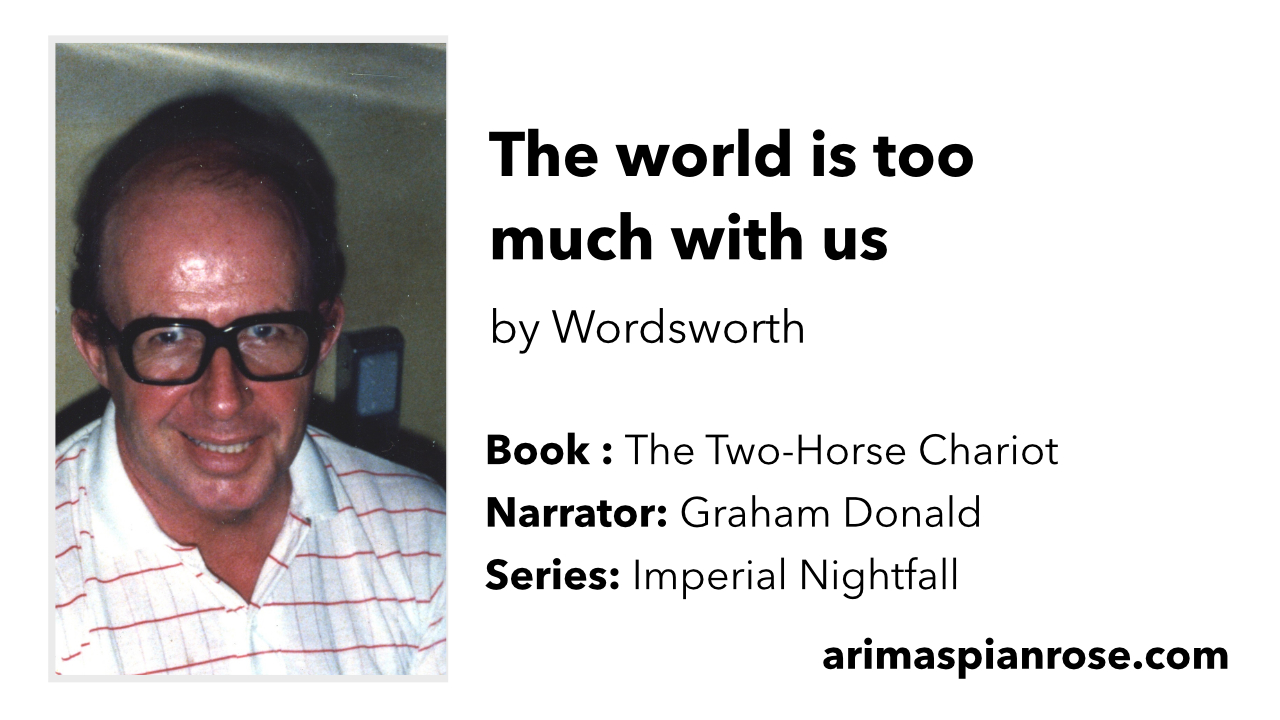
The poem “The world is too much with us” by William Wordsworth read by Graham Donald
You can hear the reading here

The world is too much with us; late and soon,
Getting and spending, we lay waste our powers;—
Little we see in Nature that is ours;
We have given our hearts away, a sordid boon!
This Sea that bares her bosom to the moon;
The winds that will be howling at all hours,
And are up-gathered now like sleeping flowers;
For this, for everything, we are out of tune;
It moves us not. Great God! I’d rather be
A Pagan suckled in a creed outworn;
So might I, standing on this pleasant lea,
Have glimpses that would make me less forlorn;
Have sight of Proteus rising from the sea;
Or hear old Triton blow his wreathèd horn.
The poem “Requiem” by Robert Louis Stevenson read by Graham Donald
You can hear the reading here

Under the wide and starry sky,
Dig the grave and let me lie.
Glad did I live and gladly die,
And I laid me down with a will.
This be the verse you grave for me:
Here he lies where he longed to be;
Home is the sailor, home from sea,
And the hunter home from the hill.
The poem “Remember Me” by Christina Rossetti read by Graham Donald
You can hear the recording here

Remember me when I am gone away,
Gone far away into the silent land;
When you can no more hold me by the hand,
Nor I half turn to go yet turning stay.
Remember me when no more day by day
You tell me of our future that you plann’d:
Only remember me; you understand
It will be late to counsel then or pray.
Yet if you should forget me for a while
And afterwards remember, do not grieve:
For if the darkness and corruption leave
A vestige of the thoughts that once I had,
Better by far you should forget and smile
Than that you should remember and be sad.
One of their Gods by C.P.Cavafy read by Graham Donald
you can hear the reading here

When one of them passed through the market place
of Seleucia, toward the hour that night falls
as a tall and perfectly handsome youth,
with the joy of immortality in his eyes,
with his scented black hair,
the passers-by would stare at him
and one would ask the other if he knew him,
and if he were a Greek of Syria, or a stranger. But some,
who watched with greater attention,
would understand and stand aside;
and as he vanished under the arcades,
into the shadows and into the lights of the evening,
heading toward the district that lives
only at night, with orgies and debauchery,
and every sort of drunkenness and lust,
they would ponder which of Them he might be,
and for what suspect enjoyment
he had descended to the streets of Seleucia
from the Venerable, Most Hallowed Halls.
The poem “Their Lonely Betters” by W.H.Auden read by Graham Donald
You can hear the reading here

As I listened from a beach-chair in the shade
To all the noises that my garden made,
It seemed to me only proper that words
Should be withheld from vegetables and birds.
A robin with no Christian name ran through
The Robin-Anthem which was all it knew,
And rustling flowers for some third party waited
To say which pairs, if any, should get mated.
Not one of them was capable of lying,
There was not one which knew that it was dying
Or could have with a rhythm or a rhyme
Assumed responsibility for time.
Let them leave language to their lonely betters
Who count some days and long for certain letters;
We, too, make noises when we laugh or weep:
Words are for those with promises to keep.
The Leaden Eyed by Vachel Lindsay read by Graham Donald
You can hear the poem here

Let not young souls be smothered out before
They do quaint deeds and fully flaunt their pride.
It is the world’s one crime its babes grow dull,
Its poor are ox-like, limp and leaden-eyed.
Not that they starve; but starve so dreamlessly,
Not that they sow, but that they seldom reap,
Not that they serve, but have no gods to serve,
Not that they die, but that they die like sheep.
Listen to Graham Donald reading “The Isles of Greece” here

Lord Byron wrote “The Isles of Greece” in 1819 as a call for Greek independence.
Greece at that time was part of the Ottoman Empire and Byron both championed, financed and participated with the Greeks in their war against the Turks.
He died in Messolongi in 1824 while still actively promoting the revolution
THE isles of Greece! the isles of Greece
Where burning Sappho loved and sung,
Where grew the arts of war and peace,
Where Delos rose, and Phoebus sprung!
Eternal summer gilds them yet,
But all, except their sun, is set.
The Scian and the Teian muse,
The hero’s harp, the lover’s lute,
Have found the fame your shores refuse:
Their place of birth alone is mute
To sounds which echo further west
Than your sires’ ‘Islands of the Blest’.
The mountains look on Marathon—
And Marathon looks on the sea;
And musing there an hour alone,
I dream’d that Greece might still be free;
For standing on the Persians’ grave,
I could not deem myself a slave.
A king sat on the rocky brow
Which looks o’er sea-born Salamis;
And ships, by thousands, lay below,
And men in nations;—all were his!
He counted them at break of day—
And when the sun set, where were they?
And where are they? and where art thou,
My country? On thy voiceless shore
The heroic lay is tuneless now—
The heroic bosom beats no more!
And must thy lyre, so long divine,
Degenerate into hands like mine?
’Tis something in the dearth of fame,
Though link’d among a fetter’d race,
To feel at least a patriot’s shame,
Even as I sing, suffuse my face;
For what is left the poet here?
For Greeks a blush—for Greece a tear.
Must we but weep o’er days more blest?
Must we but blush?—Our fathers bled.
Earth! render back from out thy breast
A remnant of our Spartan dead!
Of the three hundred grant but three,
To make a new Thermopylae!
What, silent still? and silent all?
Ah! no;—the voices of the dead
Sound like a distant torrent’s fall,
And answer, ‘Let one living head,
But one, arise,—we come, we come!’
’Tis but the living who are dumb.
In vain—in vain: strike other chords;
Fill high the cup with Samian wine!
Leave battles to the Turkish hordes,
And shed the blood of Scio’s vine:
Hark! rising to the ignoble call—
How answers each bold Bacchanal!
You have the Pyrrhic dance as yet;
Where is the Pyrrhic phalanx gone?
Of two such lessons, why forget
The nobler and the manlier one?
You have the letters Cadmus gave—
Think ye he meant them for a slave?
Fill high the bowl with Samian wine!
We will not think of themes like these!
It made Anacreon’s song divine:
He served—but served Polycrates—
A tyrant; but our masters then
Were still, at least, our countrymen.
The tyrant of the Chersonese
Was freedom’s best and bravest friend;
That tyrant was Miltiades!
O that the present hour would lend
Another despot of the kind!
Such chains as his were sure to bind.
Fill high the bowl with Samian wine!
On Suli’s rock, and Parga’s shore,
Exists the remnant of a line
Such as the Doric mothers bore;
And there, perhaps, some seed is sown,
The Heracleidan blood might own.
Trust not for freedom to the Franks—
They have a king who buys and sells;
In native swords and native ranks
The only hope of courage dwells:
But Turkish force and Latin fraud
Would break your shield, however broad.
Fill high the bowl with Samian wine!
Our virgins dance beneath the shade—
I see their glorious black eyes shine;
But gazing on each glowing maid,
My own the burning tear-drop laves,
To think such breasts must suckle slaves.
Place me on Sunion’s marbled steep,
Where nothing, save the waves and I,
May hear our mutual murmurs sweep;
There, swan-like, let me sing and die:
A land of slaves shall ne’er be mine—
Dash down yon cup of Samian wine!
The poem “The Jazz of this Hotel” by Vatchel Lindsay read by Graham Donald. You can listen here

The poem contrasts the loud, “hard and cold” artificiality of city jazz with the “slower,” natural rhythms of the sea, thunder, wind, and rural life, lamenting the loss of simpler, authentic experiences for the mechanical energy of modern urban life, with lines emphasizing nature’s deep tones (tom-toms, violin, cello) against the hotel’s jarring, unrooted sound.
The poet illuminates the conflict between the organic, timeless rhythms of nature and the frantic, artificial energy of urban life. In the concluding paradox, the jazz sounds “hot” but feels emotionally empty, harsh, and isolating compared to the warmth of nature and simple life.
Why do I curse the jazz of this hotel?
I like the slower tom-toms of the sea;
I like the slower tom-toms of the thunder;
I like the more deliberate dancing knee
Of outdoor love, of outdoor talk and wonder.
I like the slower, deeper violin
Of the wind across the fields of Indian corn;
I like the far more ancient violoncello
Of whittling loafers telling stories mellow
Down at the village grocery in the sun;
I like the slower bells that ring for church
Across the Indiana landscape old.
Therefore I curse the jazz of this hotel
That seems so hot, but is so hard and cold.